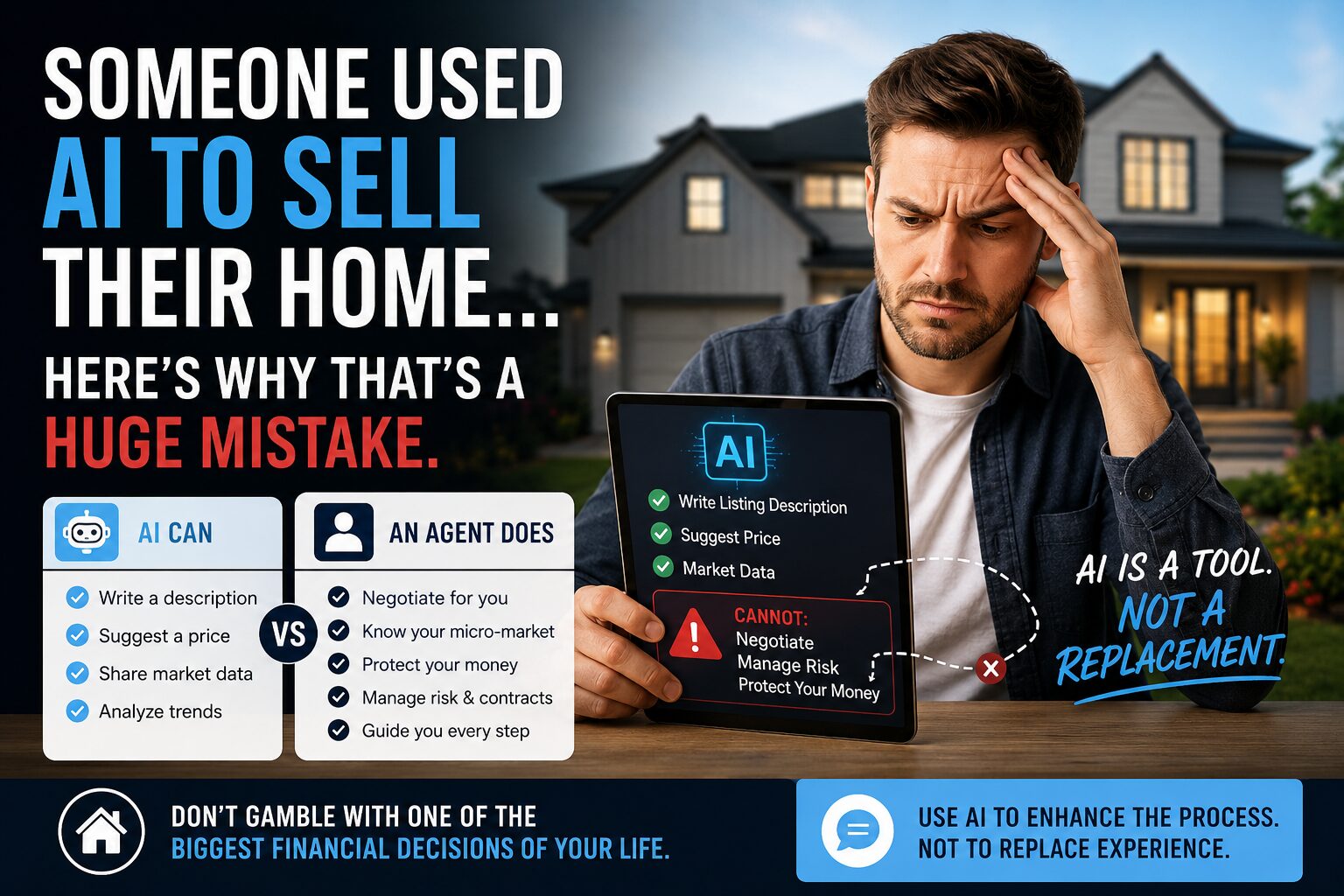
Someone Used AI to Sell Their Home… Here’s Why That’s a Huge Mistake
Artificial intelligence is everywhere right now.
It’s writing emails, generating content, answering questions, analyzing data, and helping businesses become more efficient than ever before.
And honestly? I love AI.
I use it regularly in my business to improve marketing, streamline systems, and enhance the client experience.
But lately, I’m seeing a growing trend that’s honestly concerning:
People trying to use AI to replace a real estate agent entirely.
That’s where things start to go sideways.
AI Is Smart — But Real Estate Is More Than Information
Yes, AI can generate a property description.
It can estimate pricing.
It can summarize market trends.
It can even help organize listing data.
But selling a home successfully involves far more than information.
Real estate is strategy.
It’s psychology.
It’s negotiation.
It’s timing.
And it’s risk management.
AI doesn’t sit across from a buyer’s agent during tense negotiations reading body language, leverage points, or emotional hesitation.
It doesn’t know when to push harder, when to hold firm, or when a small concession could save an entire deal.
That’s experience.
Every Neighborhood Has a Micro-Market
One of the biggest misconceptions sellers make is assuming online data tells the whole story.
It doesn’t.
Two homes on the same street can have completely different buyer demand based on layout, upgrades, lot positioning, natural light, school boundaries, traffic flow, views, or even how the home feels when someone walks through the front door.
AI can analyze data patterns.
But it doesn’t physically walk the property and recognize what buyers will emotionally connect with — or what could quietly become an objection.
That local insight matters more than most people realize.
Especially in shifting markets.
The Biggest Risk Isn’t Pricing — It’s the Contract
Most people think selling a home is about getting an offer.
In reality, getting the offer is only the beginning.
The real complexity happens after escrow opens.
Contingencies.
Inspection negotiations.
Appraisal issues.
Insurance problems.
Deadlines.
Disclosures.
Contract protection.
Liability exposure.
These are the areas where deals quietly fall apart.
And AI doesn’t manage risk.
It doesn’t protect your interests during negotiations or recognize potential legal and financial problems before they become expensive mistakes.
That’s where professional representation becomes critical.
AI Should Enhance the Process — Not Replace Experience
The truth is, AI is an incredible tool.
Used correctly, it can absolutely improve efficiency, marketing, and communication in real estate.
But replacing professional strategy and human negotiation with automation?
That’s a gamble.
And when you’re dealing with one of the largest financial decisions of your life, gambling is not a strategy.
The sellers getting the best results right now are using technology and experience together — not choosing one over the other.
The Bottom Line
AI is changing real estate.
There’s no question about that.
But successful home sales still require:
- Market expertise
- Negotiation skill
- Pricing strategy
- Buyer psychology
- Contract management
- Risk protection
- Human judgment
Technology can support the process.
But it cannot replace experience.
If you’re thinking about selling and want to know how to combine modern tools with real-world strategy to maximize your result, reach out anytime.
And follow along for honest real estate insight, smarter selling strategies, and practical market guidance.