How Much House Can You Actually Afford Right Now?
The Number Your Lender Gives You Isn’t the Number You Should Use
Here’s a conversation I have at least twice a week: a buyer gets pre-approved for $650,000, gets excited,
starts touring homes at that exact price point, and then is shocked when their actual monthly payment
comes in $400–$600 higher than they expected. The pre-approval letter isn’t lying to you. It’s just
answering a narrower question than the one you’re actually asking.
Lenders qualify you based on principal, interest, taxes, and insurance (PITI) using estimated figures —
but “estimated” is doing a lot of work in that sentence, especially here, where Mello-Roos and HOA dues
can add hundreds more that a generic pre-approval doesn’t always fully bake in. Let’s build the real
number.
Step One: Principal and Interest, at Today’s Actual Rates
As of late July 2026, 30-year fixed mortgage rates are sitting in the mid-6% range — Freddie Mac’s
weekly survey had them at 6.43% for the week of July 2, with daily trackers like Mortgage News Daily
showing 6.43%–6.60% and Mortgage Research Network at 6.73% on July 30 (Freddie Mac; Mortgage
News Daily; Mortgage Research Network). That range matters because a quarter-point swing changes
your payment more than people expect. On a $300,000 loan, here’s what principal and interest alone looks like across the realistic 2026 rate spread:
- 6.5% → $1,896/month
- 7% → $1,996/month
- 7.5% → $2,098/month
- 8% → $2,201/month
Scale that up for Corona’s actual median. With Corona’s median sale price at $799,522 (+0.3% year-over-year through May 2026) (Redfin), a buyer putting 10% down is financing roughly $720,000 — more than double that $300,000 example — so multiply accordingly before you get attached to a listing. - Step Two: Property Taxes (And Why “1%” Is a Starting Point, Not the Answer)
California’s base property tax rate is roughly 1% of assessed value under Prop 13, but that’s before local voter-approved bonds, school assessments, and — critically for many Corona and Eastvale buyers — Mello-Roos special taxes are layered on top. On a $799,522 Corona home, base property tax alone runs around $8,000/year, or roughly $665/month, before any CFD add-ons. - Step Three: Insurance, and Yes, It’s Gotten More Expensive
Homeowners insurance in Riverside County has climbed in recent years alongside wildfire risk and
statewide carrier pullbacks, and it’s a line item buyers routinely underestimate when running their own back-of-envelope math. Budget realistically here rather than copying a number from a friend’s policy in a different zip code — coverage costs vary block by block depending on brush proximity and construction type. - Step Four: The Line Item National Calculators Skip Entirely — Mello-Roos
This is the one that trips up almost every buyer moving into newer Corona or Eastvale construction.
Mello-Roos is a Community Facilities District special tax — not a percentage of home value, but a fixed formula tied to lot size or parcel — and it typically runs $1,500 to $6,000+ per year depending on the community, layered on top of your base property tax. I broke down the full mechanics, exact ranges by neighborhood, and how long it lasts in Mello-Roos & HOA Fees in Corona and Eastvale: What New Construction Buyers Really Pay — if you’re even glancing at newer construction, read that before you fall for a model home.
Stack a $300/month Mello-Roos bill with a $300/month HOA and you’ve added $600+ to your monthly
cost that builds zero equity — and because lenders count both in your debt-to-income ratio, it can
shrink your approved loan amount before you even start negotiating price.
Putting the Real Number Together
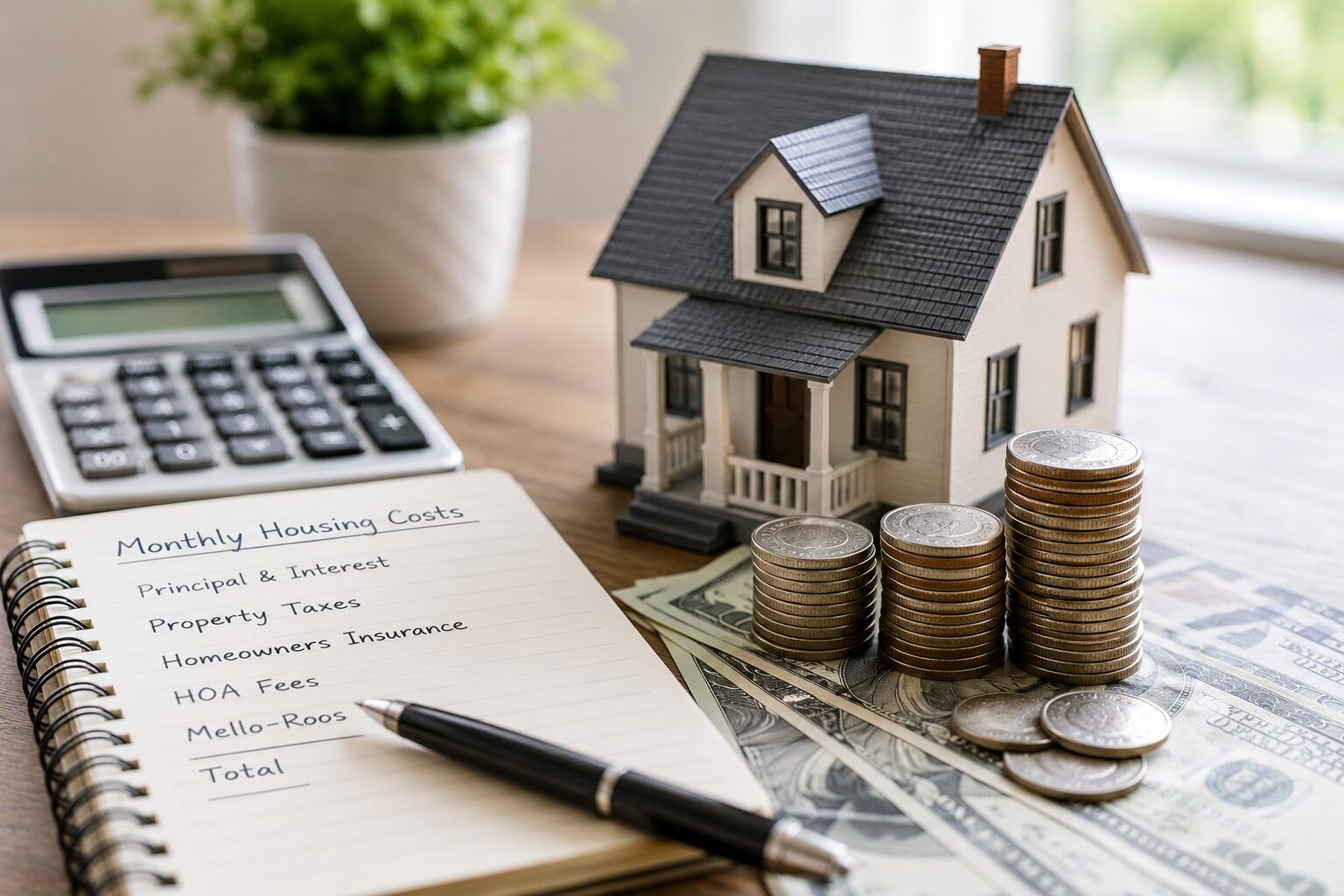
For an $800,000 Corona home with 10% down ($720,000 loan) at 6.5%: principal and interest runs
roughly $4,550/month, base property tax adds about $665/month, insurance might add
$150–$250/month, and if it’s a newer-construction community, Mello-Roos and HOA could add another
$300–$700/month. That’s a true monthly number in the $5,700–$6,200 range — not the $4,550 the rate
calculator showed you.
The Down Payment Question Changes Everything
None of this requires 20% down, by the way — that’s a separate myth worth killing. FHA gets qualified
buyers in with 3.5% down, VA loans offer true zero-down for eligible veterans, and California layers on
CalHFA and county assistance programs on top. I walk through every option, current 2026 loan limits,
and which programs are actually open right now in Zero-Down and Low-Down Payment Programs for
First-Time Buyers. Your affordability ceiling and your down payment strategy are two different conversations, and running them together is how buyers either overspend or talk themselves out of a
home they could actually afford.
Bottom Line
Affordability isn’t your pre-approval letter — it’s principal, interest, taxes, insurance, HOA, and Mello-
Roos added together for the specific parcel you’re considering, not a citywide average. Run the real
numbers before you fall in love with a floor plan, not after.
About Diana Renee
Diana Renee is a residential real estate agent and broker with Keller Williams Realty (DRE01150595), based in Corona, California. She specializes in residential sales and property management across Corona, Eastvale, Riverside, and Orange County, with deep expertise in comparative market analysis, first-time buyer guidance, and local market trends. Diana publishes regular market updates and buyer/seller guides at dianareneehomes.com and explorecorona.com.
Contact: (714) 287-0669 | dianareneehomes.com | DRE #01150595