Will Your Home Lose Value If You Wait to Sell?
The Assumption I Need to Correct First
Most sellers who ask me “should I just wait?” are implicitly assuming that waiting is the safe, no-cost
option — that the worst case is missing out on a bigger gain, not losing value outright. That assumption
is wrong often enough that I want to walk through the actual data before you decide to sit tight.
The Data Point That Should Change How You Think About “Median” Prices
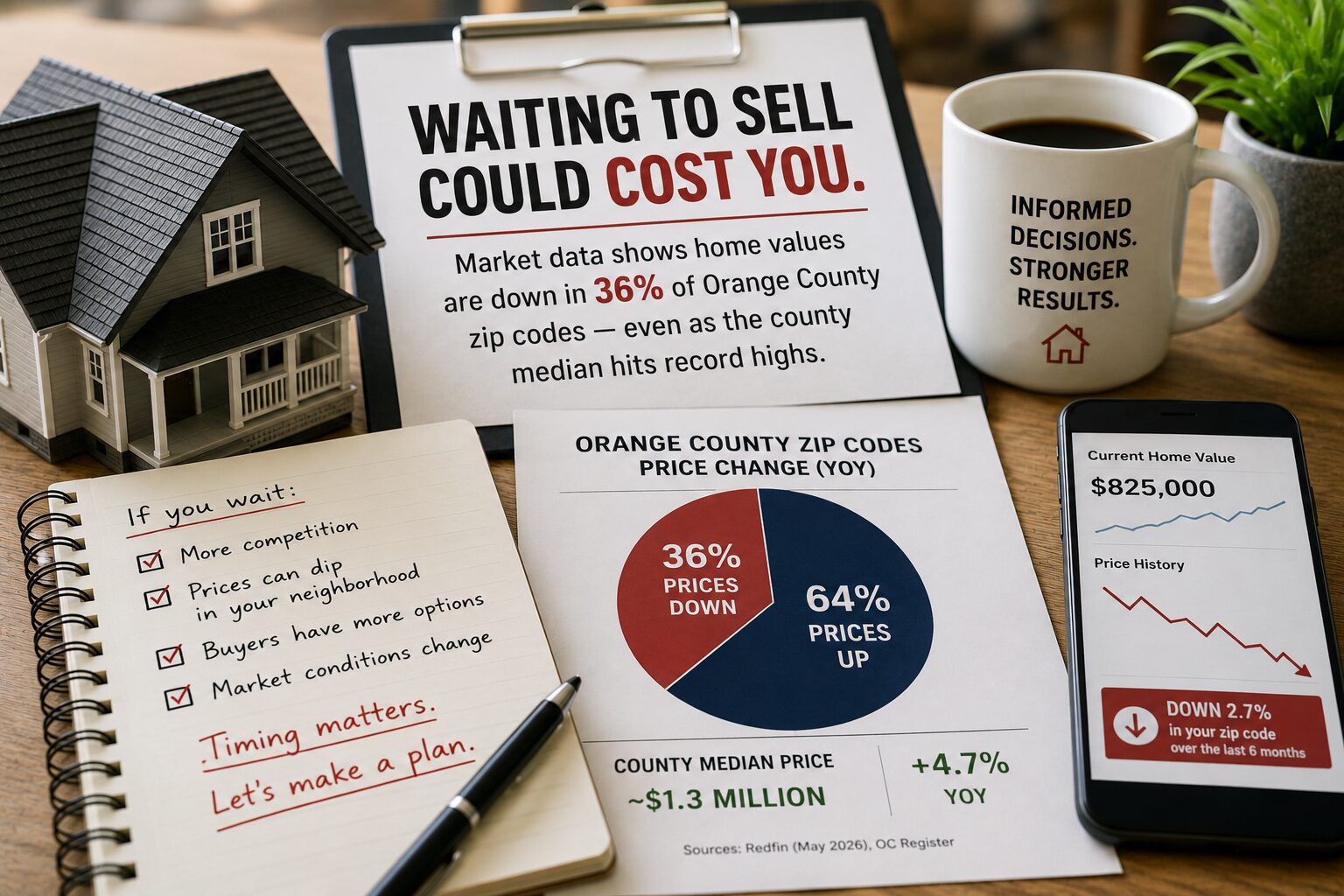
Here’s the single most important number in this whole conversation: even as Orange County’s county-
wide median hit roughly $1.3 million, up 4.7% year-over-year for the three months ending May 2026,
home prices actually dipped in 36% of Orange County zip codes
Read that again. More than a third of neighborhoods in one of the strongest housing markets in the
country were losing value at the exact same time the county-wide headline was celebrating record
highs. If that split can happen in Orange County’s hot market, it can absolutely happen in a flatter
market like Corona or Riverside County — and it’s almost certainly already happening in some zip codes
near you that a citywide average is quietly averaging away.
Why This Matters More in Corona and Riverside County Than It Might Seem
Corona’s median sale price is up just 0.3% year-over-year through May 2026 (Redfin), and Riverside
County overall is flat — $635,000 in June 2026, unchanged year-over-year and down 0.8% from May
When a market is growing at 0.3%, it doesn’t take much softening for a specific neighborhood to flip
negative — unlike Orange County’s 4.7% cushion, there’s very little buffer here. If OC’s stronger market still saw a third of zip codes decline, a flat market like ours has, if anything, less room for error, not
more.
What’s Actually Driving the Risk of Waiting
A few forces are working against the “just wait” strategy right now, and none of them are secret —
they’re all sitting in the same data you’d find if you looked:
National list prices are already falling
Nationally, list prices fell 2.4% year-over-year in May 2026 — the steepest drop in Realtor.com’s data
since 2017 (Realtor.com). Sellers who list higher than the market will support are getting corrected in
real time, not rewarded for patience.
New listings are climbing
May 2026 new listings hit their highest May level since 2022, up 2.1% year-over-year (Realtor.com).
More competing inventory means less pricing power for sellers who wait — you’re not just betting on
demand, you’re betting demand outpaces a growing supply of competitors.
The economy is cooling, not accelerating
Q2 2026 GDP grew just 1.5% annualized, down from 2.1% in Q1 and below the 2.1% consensus forecast
(BEA; UPI). June’s jobs report added just 57,000 payrolls, about half of expectations, with
unemployment ticking down to 4.2% mostly because people left the labor force rather than found jobs
(CNBC). A softening labor market and slowing growth aren’t the ingredients for a sudden price
acceleration that rewards waiting.
The Fed isn’t rescuing affordability anytime soon
The Federal Reserve held rates at 3.50%-3.75% on July 29, 2026, for a fifth straight meeting, with three
dissenters actually wanting to raise rates further due to inflation concerns (Federal Reserve; CNBC). If
you’re waiting for a rate cut to bring a flood of buyers and higher offers, that catalyst isn’t imminent
based on this decision.
The Counterargument, Fairly Stated
To be fair, it’s not all downside. Pending home sales rose nationally for a sixth straight month through
May 2026, up 4.3% year-over-year (Realtor.com), and June’s CPI inflation reading of 3.5% — down from
4.2% in May, the largest monthly decline since April 2020 — could eventually support a rate cut later in
the year (BLS; Reuters). Buyer demand hasn’t evaporated. This isn’t a crash scenario — it’s a “flat
markets have thin margins for error” scenario.
Bottom Line
Waiting to sell isn’t automatically the cautious choice — it’s a bet, and the OC zip-code data proves that
even strong county-wide markets can mask real neighborhood-level losses. In a flatter market like
Corona or Riverside County, that risk is arguably sharper because there’s less overall appreciation
cushioning a local dip. If you’re on the fence, the question isn’t “will prices go up eventually” — it’s “can
my specific neighborhood afford to be wrong.”
FAQ
Can home prices really fall even when the county median is rising?
Yes — this is exactly what happened in Orange County, where the county median hit roughly $1.3
million (+4.7% YoY) while prices actually dipped in 36% of OC zip codes at the same time (OC Register).
Is Corona’s housing market at risk of declining in 2026?
Corona’s median is up only 0.3% year-over-year, which is essentially flat rather than a strong upward
trend (Redfin). Flat markets have less cushion, meaning individual neighborhoods can dip into negative
territory more easily than in a strongly appreciating market.
Why are national list prices falling if demand is still there?
List prices fell 2.4% year-over-year nationally in May 2026 even as pending sales rose, which suggests
sellers are pricing more realistically to match what buyers will actually pay rather than demand
disappearing altogether (Realtor.com).
Should I sell now to avoid the risk of a price drop later?
If your neighborhood shows signs of softening, or you have a life reason to move regardless, waiting
purely to “see what happens” carries real, data-backed downside risk right now — it’s not the
automatically safe choice it might feel like.
How can I find out if my specific zip code is rising or falling in value?
County and city medians hide too much neighborhood-level variation to answer this on their own, as the
OC zip-code data shows. A current comparative market analysis on your specific street is the only
reliable way to know where you actually stand.
Don’t Guess With Your Biggest Asset
If you’re weighing whether to sell now or wait, let’s look at what’s actually happening on your specific
street, not just the county headline. I’ll pull real comparable sales and give you a straight answer.
About Diana Renee
Diana Renee is a residential real estate agent and broker with Keller Williams Realty (DRE
01150595), based in Corona, California. She specializes in residential sales and property
management across Corona, Eastvale, Riverside, and Orange County, with deep expertise in
comparative market analysis, first-time buyer guidance, and local market trends. Diana
publishes regular market updates and buyer/seller guides at dianareneehomes.com and
explorecorona.com.
Contact: (714) 287-0669 | dianareneehomes.com | DRE #01150595
Related reads: